
OSINT for investigative journalism
OSINT for journalists doing investigative work: verify sources, check images and trace networks with an auditable methodology. Built for freelance journalists, investigative newsrooms and fact-checkers.
What OSINT solves in a newsroom
Three problems every investigative story drags along: doubting who is really on the other end, not knowing if an image is authentic, and not understanding the digital ecosystem around the subject.
Source verification
Check whether an email, phone number or profile belongs to who it claims to be before quoting it in a piece.
Visual authenticity
Detect deepfakes, manipulation and image reuse. Recover EXIF and geolocate whenever possible.
Network mapping
Locate related profiles, bot networks or coordinated accounts around an actor.
Who uses it
Built for professionals who need to investigate with methodology and leave a traceable record.
Freelance journalists
Independent investigation on a limited budget.
Newsrooms
Investigative teams at established outlets.
Fact-checkers
Fast verification of hoaxes, images and statements.
Researchers
Independent analysis, NGOs and observatories.
The three tools a newsroom uses most
The ones that strike gold in an investigation. The rest of the catalog is there for specific cases.
Image analysis
The tool a newsroom needs most: verifying the authenticity of photos and videos before publishing.
- Deepfake and manipulation detection
- EXIF: camera, date and geolocation
- Aggregated reverse image search
- Forensic pixel analysis
Social media analysis
To map account networks, identify bots and check an actor’s narrative against their real history.
- Aggregated profile across platforms
- Fake or coordinated account detection
- Activity and context analysis
- Immutable capture for custody
Email analysis
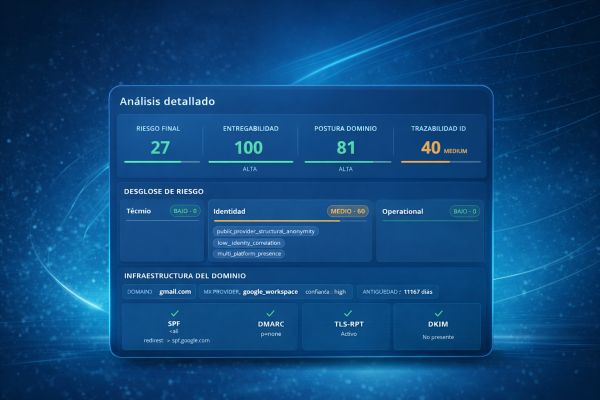
To verify an anonymous source, detect disposable emails and check for presence in leaks.
- Technical mailbox validity
- Linked accounts across platforms
- Presence in breaches and leaks
- Domain context (corporate / disposable)
Three typical newsroom cases
Practical examples of how the tools combine during an investigation.
A viral photo — real or recycled?
You upload the image for analysis: check EXIF, detect if it’s a deepfake, run reverse image search. In seconds you know whether the photo belongs to the event it’s cited for or was reused.
An anonymous source wants to reach out
You verify their email: technical validity, presence on platforms you’d expect, historical breaches. Then you cross-check phone and social media. You decide whether their profile checks out before quoting them.
An account is amplifying a narrative
You investigate the social media profile: activity, coordination with other accounts, real account age. You detect whether it’s part of a bot network or shows legitimate human behavior.
IntelMind 360 — Automatic correlation engine for newsrooms
A correlation engine that cascades through people, companies, domains and leaks until it exhausts the gold in the story. Built for anyone investigating without a technical team on hand.
Still in development. Sign up and be among the first to try it.
Frequently asked questions
What newsroom teams ask most before trying it.
Can I use IntelMind as a freelance journalist with no newsroom budget?
Are the reports usable as evidence in litigation or a criminal complaint?
Is it legal to investigate someone with your tools?
Will you index my searches or expose who I’m investigating?
How is this different from doing the searches by hand?
Does it help verify fake news and viral hoaxes?
Start with a free analysis
Your first search doesn’t use up demo credits. Try it on a real case before deciding if it fits.
About OSINT for journalists
These are the legal frameworks, institutions and authority references behind the professional use of OSINT for journalists with IntelMind: