
OSINT for SOC, CSIRT and blue teams
OSINT for SOC and CSIRT teams: fast IOC triage (IP, domain, email), phishing investigation and documented chain of custody. Built for SOCs, CSIRTs, MSSPs and threat intelligence teams.
What OSINT solves in a security operations room
Three tasks an analyst repeats several times a day that take too many minutes per ticket with manual tools.
Fast IOC triage
A suspicious IP, domain or email analyzed against 30+ sources in seconds. Reputation, hosting, RPKI, co-hosting and aggregated threat intel.
Phishing investigation
Follow a suspicious domain’s thread to its full infrastructure: WHOIS, SSL certificates, passive DNS, sibling domains and associated campaigns.
Custody for tickets
Every analysis is delivered as a PDF with a SHA-256 hash and an RFC 3161 timestamp. Attachable to a SIRT ticket or the incident report.
Who uses it
Defensive teams who need to resolve IOCs in minutes without waiting for a complex integration.
Internal SOCs
Operations teams in companies and government.
MSSPs
Managed security services and outsourced NOC/SOC.
CSIRT / CERT
Incident response teams and sector coordination.
Threat intelligence
Intelligence analysts, blue team and red/purple team defenders.
The three tools a SOC uses most
The typical entry points for triage. The rest of the catalog is there for lateral investigation.
IP analysis
To quickly enrich a suspicious IP before blocking, escalating or closing the ticket.
- ASN, geolocation, hosting/cloud, RPKI
- Aggregated reputation from 30+ threat-intel sources
- Co-hosting (domains and other assets on the IP)
- Historical passive DNS
Domain analysis
To follow the thread of a phishing domain and map a campaign’s full infrastructure.
- Historical WHOIS / RDAP
- SSL certificates and CT logs
- Sibling domains and typosquatting
- Current hosting + passive DNS
Email analysis
To validate a suspicious mailbox or a phishing campaign’s sender before sending the alert.
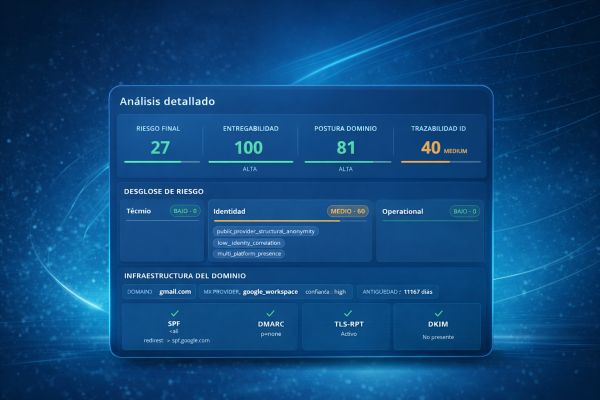
- Technical validity, MX, SPF, DKIM, DMARC
- Domain reputation and disposable detection
- Presence in leaks and breaches
- Linked accounts across platforms
Complementary for lateral investigation: phone, social media and image.
Three typical cases in a SOC room
How the tools combine on a normal day of operations.
SIEM alert triage
An alert comes in with a suspicious destination IP. You analyze it in seconds: reputation, ASN, co-hosting, threat intel. You decide whether to dismiss, block or escalate to a deeper investigation.
Phishing investigation
A domain enters the anti-phishing campaign. You trace it through WHOIS, SSL certificate, passive DNS, sibling domains. You reconstruct the campaign’s infrastructure in minutes.
Reporting to the CISO
Closing the incident: you attach each analysis’s PDF, with RFC 3161 chain of custody, to the ticket. Documentation ready for audit or a CISO presentation with no extra effort.
REST API for native SIEM/SOAR integration
Authenticated HTTPS endpoints for automated IOC enrichment from your pipeline. Native connectors for Splunk, Microsoft Sentinel, Elastic, TheHive and MISP.
Still in development. Today, analysis runs via the web interface with CSV/JSON export. Sign up if you want early access and to help us prioritize connectors.
Frequently asked questions
What SOCs and response teams ask most before trying it.
Does IntelMind integrate with my SIEM or SOAR today?
Do you support STIX/TAXII or MISP feeds?
How does it fit into a threat intelligence team?
How long does an analysis take?
Is an IntelMind report defensible in an audit or before a regulator?
Is there a dedicated plan for high-volume SOC teams?
Triage your next IP in under a minute
Free 14-day demo. Try it with a real IP or domain from your ticket queue before committing budget.
About OSINT for SOC and CSIRT
These are the legal frameworks, institutions and authority references behind the professional use of OSINT for SOC and CSIRT with IntelMind: