
OSINT for fraud prevention and KYC verification
OSINT for fraud and KYC at fintechs and banks: strengthen onboarding, KYC and fraud prevention with an OSINT layer built on public sources. For fintechs, banks, marketplaces and compliance teams.
What OSINT solves for a fraud team
Three classic frictions in the KYC process: catching synthetic identities in time, spotting fraud signals in the digital context, and leaving documentary evidence for audit.
Reinforced verification
Cross-check email, phone and image against public sources and breaches. Strengthen your IDV with OSINT signals before approving the account.
Mule and synthetic-identity detection
Fabricated identities, chained accounts, inconsistent profiles. A scoring layer on top of your rules engine.
Documentary custody
Every report is signed with a SHA-256 hash and an RFC 3161 timestamp. Useful before an auditor, regulator or dispute.
Who uses it
Teams that need to resolve KYC and fraud before the damage is already done.
Banks and neobanks
Reinforced onboarding and continuous KYC.
Fintechs
Fraud prevention in payments, lending and wallets.
Marketplaces
Buyer and seller verification.
Compliance
AML, sanctions, PEP and due diligence.
The three tools most used in KYC and fraud prevention
The typical entry points for catching fraud during onboarding and in ongoing activity.
Email analysis
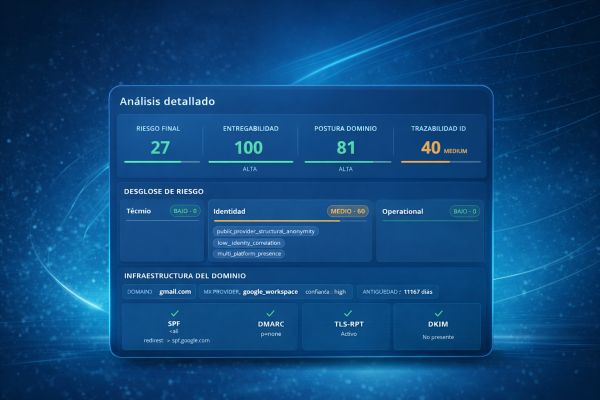
The first data point any onboarding asks for. Checks whether the account is legitimate, disposable or already flagged.
- Technical validity and domain reputation
- Disposable / temporary mailbox detection
- Presence in leaks and breaches
- Linked accounts across platforms
Phone analysis
The other key identifier. Detects burner lines, shared numbers and mule-account patterns.
- Line type (mobile, landline, VOIP, burner)
- Carrier and historical portability
- Association with accounts and leaks
- Geographic and spam risk
Forensic image analysis
Selfies, documents or liveness proofs. Detects deepfakes and manipulation before they pass the IDV filter.
- Deepfake and digital-edit detection
- EXIF: camera, date, location
- Aggregated reverse image search
- Immutable chain of custody
Also available depending on the case: social media, domain and IP.
Three typical KYC and fraud-prevention cases
How the tools combine in real fintech or marketplace flows.
Reinforced onboarding
After automated IDV, you cross-check email + phone + image against OSINT. If there are strong signals (disposable mailbox, burner number, manipulated photo), you escalate to manual review before approving the account.
Mule account in activity
An approved account starts moving money in a suspicious pattern. You re-verify its OSINT footprint: is the email still clean? did the phone change? are there links to other flagged accounts?
Dispute or claim
A customer or vendor reports fraud. You build an OSINT dossier with RFC 3161 custody that supports the decision before the regulator or the claiming party.
IntelMind vs. IDV platforms
We don’t compete with your IDV provider: we complement it. This table clarifies the roles.
| Solution | Main role | When to use it | Typical cost |
|---|---|---|---|
| IDV providers (Onfido, Veriff, Jumio) | Biometric identity verification | Onboarding mandated by regulation | €1 – €5 / verification |
| IntelMind OSINT | Intelligence layer over public sources | Onboarding reinforcement, ongoing review, disputes | Monthly credit pool |
| AML / sanctions lists (ComplyAdvantage, Trulioo) | Regulatory databases | AML/CTF compliance | Annual subscription |
| Internal fraud engines | Real-time rules and scoring | Transactional decisioning | In-house development |
IntelMind does not replace biometric IDV or regulatory lists. It adds the digital context the rest of the stack doesn’t see.
Frequently asked questions
What compliance, KYC and fraud teams ask us most.
Is IntelMind valid as KYC verification on its own?
Is it GDPR-compliant?
How does it fit into my onboarding pipeline?
Does it also work for AML and Enhanced Due Diligence (EDD)?
Is there a monthly search limit?
Can I present an IntelMind report to a regulator or auditor?
Reinforce your KYC in 5 minutes
Free 14-day demo. Try a reinforced verification on a real case from your pipeline before committing budget.
About OSINT for fraud and KYC
These are the legal frameworks, institutions and authority references behind the professional use of OSINT for fraud and KYC with IntelMind: